

First published: 11 March 2020 · Last updated: 27 May 2026
In this article
- SEO and SEM: What They Actually Mean
- Where Meta Ads Fit In (And Where They Don't)
- The Core Differences Between SEO, SEM, and Meta Ads
- How to Decide: SEO, SEM, Meta Ads, or All Three?
- A Common Myth: Does Running Google Ads Improve SEO Rankings?
- The Singapore-Specific Angle Most Agencies Miss
- The Bottom Line: It's the Right Mix, Not One Channel
- FAQ
- Not Sure Where to Start?
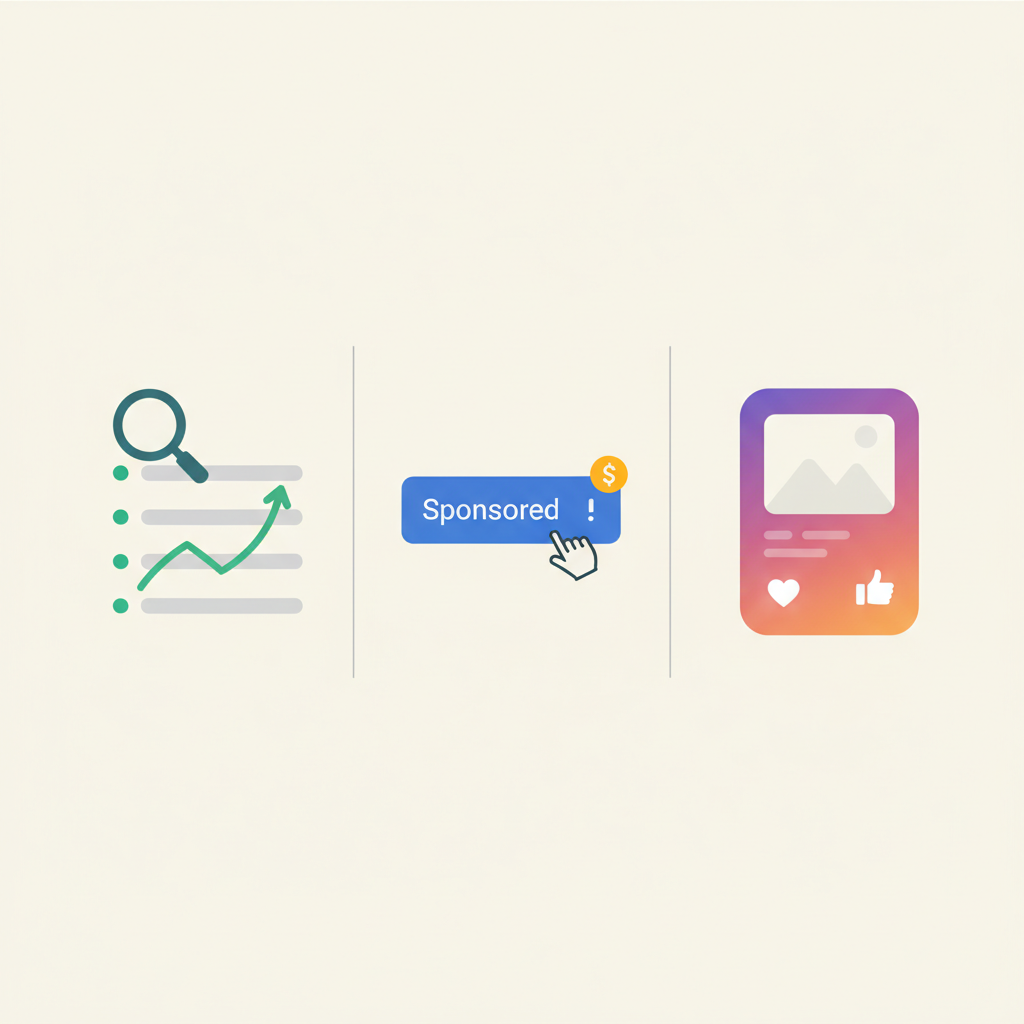
If you've been researching how to get more customers online, you've probably stumbled across three terms that sound almost interchangeable: SEO, SEM, and Meta Ads (also called Facebook or Instagram Ads). Picking which one (or which mix) is right for your business is one of the most important decisions you'll make for your marketing budget. Get it wrong, and you'll either burn cash on clicks that don't convert, or wait six months for organic traffic that never comes.
I'm Jim Ng, founder of BestSEO.sg, and I've been running SEO and paid campaigns for Singapore businesses since the early days of Google Ads (back when it was still called Google AdWords). Let me walk you through what actually matters when choosing between these channels in 2026.
SEO and SEM: What They Actually Mean
Search Engine Optimisation (SEO)
SEO is the process of earning your spot on Google's organic results. You do this through technical website improvements, content creation, and building your site's authority over time. When someone searches “best CRM software Singapore” and clicks on a non-ad result, that's organic traffic. You didn't pay Google a single cent for that click.
But “free” is misleading. You pay with time, effort, and often the cost of hiring someone who knows what they're doing. The investment goes into your website itself, not into Google's advertising platform. If you're looking for a partner to handle this end to end, our SEO service packages set out exactly what's included at each tier.
Search Engine Marketing (SEM)
SEM, also called pay-per-click (PPC) advertising or Google Ads, is the paid shortcut. You bid on keywords, write ad copy, and your listing appears above the organic results with a small “Sponsored” label. Every time someone clicks, you pay. The cost per click in Singapore ranges from $0.30 for low-competition terms to over $60 for competitive industries like insurance, legal services, and private education.
Think of it this way. SEO is like building a hawker stall with a loyal following. It takes time, but once the queue forms, it sustains itself. SEM is like renting a prime spot at a food expo. You get instant foot traffic, but the moment you stop paying rent, the traffic disappears. If SEM is your starting point, our Google Ads service in Singapore walks through how we structure the account before anyone burns a dollar on clicks.
Where Meta Ads Fit In (And Where They Don't)
Meta Ads is the umbrella term for paid advertising on Facebook, Instagram, Messenger, and Threads. Unlike SEO and SEM, where you reach people who are actively searching for what you offer, Meta Ads interrupt people while they scroll. You target by interest, behaviour, demographic, and lookalike audiences, not by what someone typed.
That single difference, search intent versus interest-based interruption, changes everything about when Meta Ads work and when they don't.
Meta Ads work brilliantly when:
- Your product or service is visual (clinics, restaurants, fitness, fashion, beauty, lifestyle brands).
- Buyers don't know they need you yet. “Hidden demand”, as I call it. Most people aren't googling “subscription meal-prep service in Singapore” until they see an ad that makes them realise they want one.
- You have decent creative production capacity, or can outsource it. Meta is a creative-driven channel. Bad creative kills good targeting.
- You're comfortable with a longer attribution window. Meta often plants the seed; the purchase happens days or weeks later through a different channel.
Meta Ads struggle when:
- Your offer is technical or hard to explain in a 6-second video (most B2B SaaS, complex legal services, niche industrial products).
- You're a pure search-intent business (a plumber, an emergency aircon repair service, a tax accountant). People with that intent go to Google, not Instagram.
- You can't produce or commission creative regularly. One static image running for three months will burn out, and your CPM will spike.
- Your sales cycle is over six months and you don't have the patience for nurture-driven attribution.
The Singapore-specific twist: Meta Ads CPMs in Singapore are among the highest in Southeast Asia (typically S$8 to S$25 per 1,000 impressions depending on audience), but conversion rates tend to be solid because Singaporean consumers are mobile-first and high-trust. If your offer matches the channel, Meta is the fastest way to scale demand here. If it doesn't, you'll spend twice as much per lead as you would on Google Ads. For a deeper look at the SG agency landscape on this channel, our team has reviewed the best social media agencies in Singapore.
The Core Differences Between SEO, SEM, and Meta Ads
Let me go deeper than the usual comparison table. Here are the differences that actually affect your bottom line.
Cost structure. With SEM and Meta, your cost is directly proportional to traffic or impressions. If you need 1,000 clicks and your average CPC on Google is $3.50, you're spending $3,500. On Meta, the cost is usually per impression (CPM) plus per click, with leads costing anywhere from $5 to $80+ depending on industry. Next month, same thing. The cost doesn't decrease over time unless you get better at optimising creative (Meta) or Quality Score (Google). SEO, by contrast, has an upfront investment that converts to near-zero marginal cost once you rank.
Time to first lead. SEM: hours. Meta: 1 to 7 days (the algo needs to learn). SEO: 3 to 9 months for commercial keywords, longer for competitive ones. If you cannot afford to wait, our guaranteed page-one ranking program is the closest SEO comes to a cashflow-style channel.
Compounding behaviour. SEO compounds. SEM and Meta don't. If you stop SEM today, leads stop tomorrow. If you stop SEO today, leads keep coming for months because your existing rankings keep delivering traffic.
Buyer intent. SEM captures the highest intent (“plumber Tampines now”). SEO captures medium-to-high intent (“best plumber Singapore”, “how to fix water heater”). Meta captures interest, not intent, so the buyer needs more nurturing to convert.
Creative requirements. SEM: ad copy and landing page. Meta: high-frequency creative production (video, static, carousel), refreshed every 4 to 6 weeks before fatigue sets in. SEO: long-form written content, ideally evergreen.
Attribution clarity. SEM is cleanest (search to click to conversion). SEO is murky-but-clear (organic session to conversion, but harder to attribute to specific keywords post iOS17). Meta is the murkiest (view, multi-day delay, conversion attributed by Meta's pixel, often overlapping with other channels).
How to Decide: SEO, SEM, Meta Ads, or All Three?
Go with SEM first if:
- You're a search-intent business (services, B2B, professional advice).
- You need leads this month, not in six months.
- You have $3,500+/month combined (agency + ad spend) for at least three months of learning.
- Your landing pages are conversion-ready (clear offer, fast load, mobile-optimised).
Go with Meta Ads first if:
- Your offer is visual or impulse-driven (consumer brands, lifestyle, e-commerce, clinics with visible outcomes).
- You want to create demand among people who weren't searching yet.
- You can produce or commission fresh creative monthly.
- You have $2,500+/month combined and at least two weeks for algo learning.
Prioritise SEO if:
- You can wait 6 to 12 months for compounding returns.
- Your buyers research extensively before buying (B2B SaaS, professional services, considered purchases).
- You want a defensible long-term asset, not just monthly cashflow.
- You have 12+ months of runway and at least $2,300/month for a real retainer.
Run all three simultaneously if:
- You're past $2M in annual revenue and need coordinated growth.
- You can afford $8,000 to $20,000/month combined.
- You have or can hire someone (in-house or agency) to manage attribution across the three channels so they reinforce rather than compete.
- You understand that channels lift each other. SEO content fuels Meta Ad landing pages; Meta retargeting catches Google ad clickers who didn't convert; SEM data tells SEO which keywords actually generate revenue.
A Common Myth: Does Running Google Ads Improve SEO Rankings?
No. Google has stated this publicly and repeatedly. Paying for Google Ads doesn't influence your organic rankings. They're separate algorithms with separate teams.
But there's a softer indirect effect. Running SEM gives you keyword data (which terms actually convert), which you can then prioritise for SEO. So the data from paid informs your organic strategy, even if the spend doesn't directly help rankings. The same applies to Meta Ads: it doesn't help your Google ranking, but the audience data and lookalike learnings can sharpen your SEO content angle if you pay attention.
How to Evaluate Keyword Competition for SEO vs SEM
For SEM, evaluate the auction. Use Google Keyword Planner to check CPC ranges. If the top-of-page bid for “wedding photographer Singapore” is $8 and your average customer pays $2,500 with a 5% close rate, your max CPA is $125 and you can afford up to $25 per click (for every 5 clicks you get 1 booking). If the CPC is $8, you have margin. If it's $40, the auction prices you out unless your conversion rate is exceptional.
For SEO, evaluate the SERP. Look at the top 10 results. Are they dominated by domains with DR 70+ (like CNA, Forbes Singapore, government sites)? You won't outrank them without years of investment. Are they smaller niche sites and forums? You have a real chance with 6 to 12 months of focused work. Look at content depth, schema, freshness. The gap between you and rank 1 tells you the lift required.
The Singapore-Specific Angle Most Agencies Miss
Most marketing advice you read online comes from US or UK-centric agencies. Their advice doesn't perfectly translate to Singapore for three reasons.
First, Singapore's search volumes are tiny. Even a “high-volume” keyword in Singapore might be 500 searches a month, where the US equivalent is 50,000. This means SEO requires you to rank for more long-tail terms, not just go after the obvious head terms.
Second, Singapore's audiences are bilingual. English dominates, but Mandarin terms drive significant volume in certain verticals (TCM, traditional services, education). Ignoring Mandarin terms leaves money on the table.
Third, Singapore's buying journey is faster than the US equivalent. Average consideration time on professional services is 2 to 4 weeks here, versus 6 to 8 weeks in the US. This means Meta Ads can produce direct conversions more often than you'd expect, and SEO returns kick in slightly faster because buyers don't drag out research as long.
The Bottom Line: It's the Right Mix, Not One Channel
For most Singapore SMEs doing $300k to $5M a year, the right answer is not picking one channel. It's sequencing them.
Months 1 to 3: Start with the channel that matches your buyer behaviour. Search intent goes SEM. Interest-based goes Meta. Use this phase to generate immediate cashflow and learn which keywords or audiences actually convert. If you're evaluating who can run paid for you, the team has compiled the best Google Ads agencies in Singapore.
Months 3 to 6: Add SEO using the keyword data from your paid campaigns. The terms that converted in SEM become your priority SEO targets. You now have a paid channel funding the business while SEO compounds in the background.
Months 6 to 12: Add the third channel if your offer supports it. A search-intent business that started on SEM can layer in Meta retargeting; a visual brand that started on Meta can add Google Ads for the high-intent buyers who eventually search after seeing your Meta content.
Year 2 onwards: Your SEO traffic should be growing month-on-month. You can begin to reduce SEM spend on terms where you now rank organically, redirecting that budget into Meta Ads or new SEO clusters. This is the compounding effect that makes SEO worth the wait.
FAQ
Which is best for Singapore SMEs: SEO, SEM, or Meta Ads?
If forced to pick one, choose by buyer behaviour. Google Ads (SEM) for high-intent service businesses, Meta Ads for consumer brands and visual offers, and SEO for long-cycle B2B with at least six months runway. Most Singapore SMEs benefit from running at least two coordinated.
How much does each channel cost in Singapore?
SEO retainers from $2,300/month. SEM management $1,500 to $3,000/month plus $2,000+ in ad spend. Meta Ads management $1,500 to $3,000/month plus $1,000+ in ad spend. Combined floor for a multi-channel program: around $6,000 to $8,000/month including ad budget.
Does Google Ads (SEM) affect my SEO rankings?
No. Google has confirmed there's no algorithmic link between Ads spend and organic ranking. However, the keyword and conversion data from SEM helps prioritise which terms are worth investing in for SEO.
Should I run SEO or paid ads first?
Run paid first if you need leads in the next 30 to 60 days. Run SEO first if you have at least six months of runway and want a compounding asset. Most SMEs we work with start with paid and add SEO from month three onwards.
Can I get business grant support for SEO, SEM, or Meta Ads in Singapore?
Yes, through a Pre-Approved Solution. SMEs are eligible for up to 50% business grant support for adopting one, subject to the government's eligibility criteria.
What is AEO, and does it replace SEO?
AEO (Answer Engine Optimisation) is optimising to be cited inside AI engines like Google AI Overview, ChatGPT, Perplexity, and Claude. It doesn't replace SEO. It sits alongside it. Both pull from the same content, but the formatting requirements differ. In 2026, you need both because half of Singapore buyers no longer scroll past the AI answer.
Not Sure Where to Start?
If you've read this far and you're still not sure whether SEO, SEM, or Meta Ads is right for your business (or what mix makes sense), the easiest next step is to book a free strategy session. We'll look at your specific search performance, current paid spend, and offer mix, and give you an honest assessment of where each channel makes sense for you. No hard sell. Just a straightforward conversation about what the data says and what we'd do if we were in your shoes.